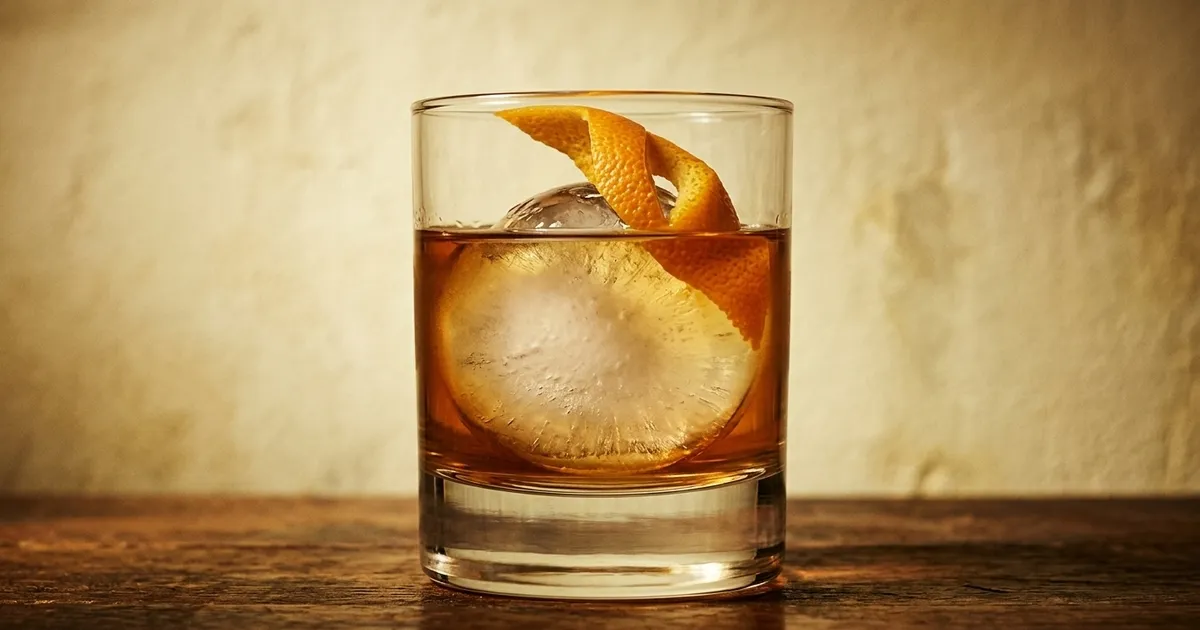
Tale of a Cocktail: Old Fashioned
There’s a face a bartender pulls when someone orders an Old Fashioned at half nine on a Friday. It isn’t complete contempt, though there is a bit of that. It’s just maths. Somewhere under the bar is a demerara cube that has to be crushed into a paste with two dashes of bitters, by hand, while eleven other people wait for things that can be poured over ice in six seconds.
The drink is two hundred years old and has never got faster to make. The history of the Old Fashioned is very largely the history of people trying to fix that, and of other people telling them to stop.
The name is a complaint
Nobody calls a drink old fashioned while it’s still in fashion. For the first seventy years of its life this one had no name at all, because there was nothing to distinguish it from. When a reader of the Balance and Columbian Repository, a paper in upstate New York, wrote in to ask what the word “cock-tail” actually meant, the editor’s reply of 13 May 1806 is the earliest definition anyone has found: spirits of any kind, sugar, water and bitters. That was the entire drink, and the entire category. It was also, the editor added, commonly called a bittered sling.
By the 1870s bartenders were embellishing — absinthe, maraschino, curaçao, Chartreuse — and Jerry Thomas’s 1876 revision of his bar guide carries the Improved Whiskey Cocktail, maraschino and absinthe included, a drink his 1862 edition had felt no need for. Anyone who still wanted spirits, sugar, water and bitters now had to say so. They asked for it the old fashioned way, and the qualifier stuck to the drink the way nicknames do when somebody else picks them.
The Louisville problem
The story you’ll usually be told instead puts the invention at the Pendennis Club in Louisville, where a bartender is said to have made it for Colonel James E. Pepper, who then carried it to the bar at the Waldorf-Astoria in New York. It’s a good story, and it comes with a distillery attached, which is generally a sign to check the dates.
They don’t hold. The Chicago Daily Tribune was writing about old fashioned cocktails in February 1880, and the Pendennis Club didn’t open until 1881. The story itself doesn’t appear in print until 1931, in Albert Stevens Crockett’s Old Waldorf Bar Days — half a century after the event it describes, written down by someone who wasn’t there. Wondrich, Simonson and Difford have all looked at it and reached the same conclusion. The club’s own position has since softened into a claim about being first to muddle fruit and syrup into it, a distinction no-one else wants.
What the fruit did
The four ingredients survived Jerry Thomas. They did not survive Prohibition. Somewhere after repeal the sugar cube acquired an orange slice and a maraschino cherry to be crushed alongside it — plausibly to cover whiskey that had spent its formative months in a bathtub, though the habit comfortably outlived the reason.
What was left by the 1970s was a drink with a fruit salad in the bottom of it, ordered mostly by people who had been ordering it since before the war, which is how it spent two decades as the thing your grandfather drank, at least for Americans. It took the mid-1990s revival, and in London a good deal of Dick Bradsell, to get the fruit back out again.
Few would recognise the drink of the 1970s as an Old Fashioned today, but there’s still a debate about how much of anything besides whiskey belongs in there. The finished drink should read as neither sweet nor bitter. Sugar and bitters are there to take the edge off the spirit and add a note under it, not to be tasted on their own, and a build where you can pick either of them out has failed.
Cube or syrup
The cube is traditional, but it’s tiresome and slow in my opinion — muddling it to a paste is the only genuinely time-consuming step in a drink that is otherwise four ingredients and a stir — and it does not reliably dissolve, which is where the grit in the bottom of the glass comes from. Neither of those is a tradition worth defending.
Demerara syrup does the same job instantly and disappears completely. 100g demerara sugar, 50g water, a small pan over gentle heat, stirred until the sugar is gone. Cool it and bottle it into something sterilised. It won’t keep forever, but it will comfortably outlast a few dozen Old Fashioneds, and the bottle lives in the fridge door where the cube never had to.
Contrary to what’s been said above, some fruit does improve the drink — a coin-sized piece expressed into the glass to be gently mixed with the syrup and bitters, along with a larger swathe expressed over the top, is my preference. Get as much of the white pith off as you can before it goes anywhere near the glass — pith adds an unpleasant bitterness, unlike the aromatic bitters, which add complexity. The same oils do the same job as a garnish in Revolver, Les Paul and The Maloney No. 2.
How I make it
I have had a bottle of demerara syrup in the fridge door for years and I have never gone back to the cube.
- 2.5oz Woodford Reserve Double Oaked or Angel’s Envy bourbon
- 1 barspoon demerara syrup (2:1)
- 1 dash Bob’s Bitters Abbot’s Bitters
- 2 slices of orange peel
You don’t need to use a premium bourbon, but it’s a habit I picked up during lockdown and have been unable to drop since. The Woodford makes a spicier drink, Angel’s Envy a sweeter one. Abbot’s over Angostura because it’s darker and less aggressively spiced, and at a single dash it sits underneath the whiskey instead of arguing with it. Build in the glass over one large cube of ice, stir twenty times or so, express one piece of peel over the top and drop both in.
My preferred build is on the site if you want the reference point before you start adjusting it. Adjust it. Everyone has, for two hundred years — the name is just what happens when enough people go too far.
Header image created using AI.